
Indian Stock Market • Educational Guide

Stop Chasing Tips.
Start Understanding the Rules.

Learn how investing, trading, technical analysis, options, and risk management fit together - with practical examples, clear calculations, and tools to help you make more informed decisions.

  • A rule before every trade: Turn vague ideas into objective Strategy Cards with defined entry, invalidation, stop-loss, and sizing before capital moves.
  • The real cost stack: Uncover how STT, stamp duty, GST, exchange charges, and slippage can turn a winning price move into an actual loss.
  • The maths of staying in the game: Position sizing from rupee risk, surviving losing streaks, and understanding why -50% drawdown requires +100% recovery.
  • AI as an assistant, not an oracle: 4 verification gates to prevent look-ahead bias, catch hallucinations, and protect API keys under SEBI retail algo rules.
$9 $49 Save $40 (~82% OFF)
Secure digital download after successful payment • High-Res PDF & Reflowable EPUB
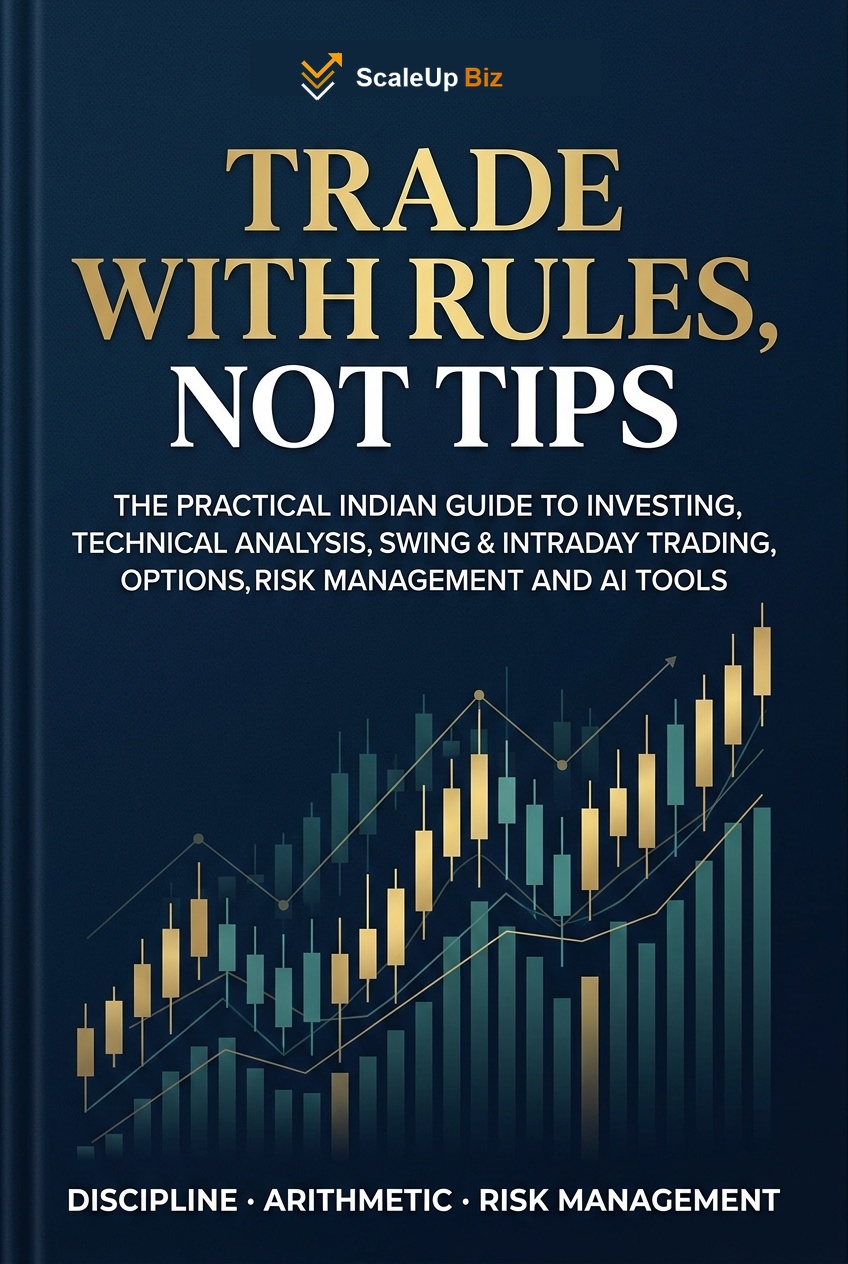
Trade With Rules, Not Tips eBook Cover Mockup - ScaleUp Biz
158 Pages • 18 Charts • Complete Guide
The Real Challenge

Why Most Traders Lose Money in Indian Markets

SEBI's comprehensive studies found that nearly 9 out of 10 individual traders in equity derivatives made net losses. The problem isn't a lack of effort - it's following tips without understanding how markets, costs, and risk actually work.

1. Chasing Telegram & WhatsApp Tips

A tip is someone else's decision that you borrow. You don't know why they took it, when they'll change their mind, or where they will cut losses. When a tip fails, you have nothing to learn from.

The Rule: Decide your entry, stop, and invalidation criteria before putting a single rupee at risk.

2. Underestimating the Cost Stack

Every trade carries STT, brokerage, exchange charges, SEBI fees, stamp duty, and 18% GST. On small, frequent trades, these charges eat your profits. A share can rise and you can still lose money.

The Rule: Calculate your break-even hurdle in advance so you know the exact minimum move required.

3. Confusing Investing With Trading

Many beginners trade like investors (panicking on every hourly dip) or invest like traders (converting losing intraday positions into delivery "waiting for it to come back" with unhedged gap risk).

The Rule: Separate your long-term portfolio from your trading capital with dedicated rules for each.

4. Entering Without Predefined Risk

Buying shares or options without knowing the exact rupee amount you are prepared to lose. Or setting a stop "in your head", which always gets moved lower when emotion takes over.

The Rule: Size every position from the stop distance and cap position value to survive losing streaks.

5. Cluttered Indicator Traps

Pasting seven oscillators onto a chart and assuming they provide seven confirmations. In reality, RSI, stochastics, and MACD all measure past price - meaning one piece of evidence shown three times.

The Rule: Use one tool per job (trend, timing, volatility) and let price structure and volume lead.

6. Blind Trust in Unverified Predictions

Asking an unverified bot or formula "will this stock rise next week?" generates plausible text, not an edge. Unchecked code can introduce subtle look-ahead bias that buys at the open using that day's close.

The Rule: Put human verification gates in front of every automated formula, backtest script, and financial summary.
87.7% of individual F&O traders made a net loss in FY26, after transaction costs. Source: SEBI Study (August 2026) [S-03]
0.5% only of individual F&O traders were profitable across all 5 consecutive years (FY22 - FY26). Source: SEBI Broker Study [S-04]
71% of individual intraday cash traders made a net loss; rising to 80% for frequent traders. Source: SEBI Study [S-05]
Complete Curriculum

What You Will Learn Inside the 19 Chapters

Structured progressively from market foundations and financial statement reading to technical routines, options mechanics, risk management, and backtesting.

Part I • Chapters 1-3

1. Indian Stock Market Foundations

Understand what you actually own when buying a share, who regulates the system, and how money and shares flow.

  • The Bakery Example: What a share really represents
  • Who does what: SEBI, NSE, BSE, Brokers, Clearing Corps & Depositories
  • Demat vs Trading accounts, KYC, and nominee protection
  • Market hours, pre-open sessions, and the T+1 settlement cycle
Part I • Chapter 2

2. Orders, Costs & New Tax Basics

Master the mechanics of order execution, reading market depth, calculating true trade friction, and 2026 tax rules.

  • Market, Limit, and Stop-Loss orders (and the risk of gaps)
  • Order books: Bids, Asks, Spreads, and Walking the Book
  • Delivery vs Intraday full cost breakdown with worked arithmetic
  • Income-tax Act, 2025: STCG (20%), LTCG (12.5%), and STT rules
Part II • Chapters 4-6

3. Investing for Beginners: Numbers & Portfolios

Build a wealth engine without a finance degree. Connect financial statements, detect red flags, and manage asset allocation.

  • Connecting the 3 statements: P&L, Balance Sheet, and Cash Flow
  • 6 key ratios: Growth, Margins, ROE, ROCE, Debt-to-Equity & FCF
  • Red flags: profit without cash, surging receivables, promoter pledges
  • Index funds, ETFs, core-and-satellite sizing, and rebalancing
Part III • Chapters 7-10

4. Technical Analysis & Chart Routines

Read what buyers and sellers actually did. Master support/resistance zones, volume confirmation, and top-down timeframe analysis.

  • Candlestick anatomy and 6 common patterns (and their limits)
  • Trends: Swing highs/lows, market structure, and transition states
  • Support & Resistance zones (not lines), breakouts and retests
  • Top-Down Analysis: Weekly direction, Daily setup, Hourly timing
Part IV • Chapter 11

5. Swing Trading: Rules-Based Framework

Build repeatable swing trade setups for holding days or weeks, with explicit trigger rules, invalidation levels, and partial exits.

  • Strategy Card 1: Trend Pullback with buy-stop confirmation
  • Strategy Card 2: Breakout & Retest with volume filters
  • Position limit vs Risk budget (how tight stops can mislead)
  • Full walkthroughs: The Godavari Pipes win & Tapti Ceramics results gap
Part IV • Chapter 12

6. Intraday Trading: Process Before Profit

Disciplined execution for same-day trading. Recognize trend vs range days, use VWAP properly, and enforce strict daily stops.

  • The 3 honest questions: Time, Temperament, and Cost hurdle
  • Strategy Card: Opening-Range Breakout (ORB 9:15-9:30)
  • Strategy Card: VWAP Reclaim on verified trend days
  • Why scalping is the hardest form of trading (83% eaten by fees)
Part V • Chapters 13-14

7. Futures & Options: Greeks & Spreads

Demystify derivatives without the hype. Understand contract values, margin leverage, the Greeks, and defined-risk spreads.

  • SEBI minimum contract sizes (₹15-20 lakh) and leverage maths
  • Plain-language Greeks: Delta, Gamma, Theta decay, and Vega
  • Defined-risk Bull Call & Bear Put Spreads vs single options
  • The 8-Question F&O Readiness Checklist before trading
Part VI • Chapters 15-16

8. Risk Management, Drawdowns & Psychology

The mathematical seatbelt of trading. Calculate position size from rupee risk, understand risk of ruin, and build process controls.

  • Position Sizing Formula: Rupee Risk ÷ (Entry - Stop)
  • Drawdown Mathematics: Why recovering from -50% takes +100%
  • Risk of ruin simulation: 20,000 runs and the reality of 6-loss streaks
  • Process score vs Outcome: The dangerous luck of bad trades that win
Part VII & VIII • Ch 17-19

9. Backtesting, Quantitative Workflows & Checklists

Test strategies honestly before risking money, test rules safely with 4 human gates, and print out your complete toolkit.

  • Eliminating Look-Ahead Bias, Survivorship Bias, and Overfitting
  • The 4 Human Gates for strategy code: Sources, Numbers, Code, Practice
  • SEBI's 2026 retail algorithmic trading regulations & API security
  • 16 Complete checklists: Pre-market, screening, journal & risk policy
Visual Architecture

Inside the eBook: 18 Proven Visual Frameworks

Every critical concept in the book is paired with an authentic diagram, synthetic chart walkthrough, and reproducible calculation.

Figure V01 • Lifecycle of an Indian Equity Trade
1. Investor (Riya) places buy order in broker app (₹450)
↓ Order Routed
2. Stockbroker (SEBI-registered) passes order to exchange
↓ Electronic Order Book Match
3. Stock Exchange (NSE or BSE) matches buyer with seller
↓ Trade Settlement Guarantee
4. Clearing Corporation (NSE Clearing / ICCL) guarantees pay-in/pay-out
↓ T+1 Electronic Credit
5. Depository (NSDL / CDSL) credits shares into Riya's demat in her name

How Riya's Order Travels (Chapter 1)

Buying a share from a stranger requires systemic trust. India’s market achieves this by splitting responsibilities across independent entities: SEBI as referee, NSE/BSE as marketplaces, clearing corporations as guarantors, and NSDL/CDSL as custodial depositories.

Your money and your shares travel on completely separate tracks. The depository credits shares to your own demat account - in your name, never the broker’s.

Key Rule: Shares settle on a T+1 cycle. Until settlement completes, shares are not fully in your custody. Selling them before that is an intraday trade with different cost and margin rules.
Chart V03 • Where The Money Goes (Contract Note Reality)
Charge Item Delivery Trade (₹1.23L traded) Intraday Trade (₹4.81L traded)
Brokerage ₹40.00 (₹20 × 2) ₹40.00 (₹20 × 2)
Securities Transaction Tax (STT) ₹123.00 (0.1% buy + sell) ₹60.30 (0.025% sell only)
NSE Transaction Charge ₹3.78 ₹14.77
SEBI Turnover Fee ₹0.12 ₹0.48
GST (18% on fees) ₹7.90 ₹9.95
Stamp Duty ₹9.00 (0.015% buy) ₹7.20 (0.003% buy)
DP Depository Charge ₹15.00 ₹0.00
Total Costs Deducted ₹198.80 ₹132.70

The Full Cost Stack & The Break-Even Hurdle (Chapter 2)

Arjun placed his first intraday trade, saw the share rise by 50 paise, sold 200 shares for a ₹100 gross gain, and received a contract note showing a net loss of ₹32.39.

Why? Because total transaction costs were ₹132.39. On 200 shares, that created a break-even hurdle of ₹0.66 per share. If the stock didn't move by more than 66 paise in his direction, he was guaranteed to lose money.

Key Rule: Every trading setup must clear its cost hurdle before it can show an edge. Frequent trading without accounting for statutory levies is the #1 silent killer of accounts.
Chart V06 • Candlesticks as Words, Market Structure as Sentences
Hammer (Lower Wick)
Buyers pushed price back up after a dip. Valid only when testing a rising swing low.
Shooting Star (Upper Wick)
Sellers pushed price back down after a rally. Important when testing ceiling resistance.
Bullish Engulfing
Up candle body completely covers previous down candle. Needs volume confirmation.
Inside Bar (Consolidation)
Range sits inside previous bar. Volatility contraction preceding potential breakout.

Price Action & Context Over Patterns (Chapters 7 & 8)

A single candle is a word. A trend is the sentence. A hammer in the middle of a steep downtrend has almost zero statistical value. The exact same hammer forming at an established support zone after a pullback in a weekly uptrend is an actionable question.

The book introduces the rigorous 6-step chart-reading framework: Look, Identify, Interpret, Confirm, Plan, Review.

Key Rule: Keep observation, interpretation, and decision separate. Observation: "Price closed at ₹101.90 after touching ₹97.40." Decision: "I will act only if the next candle closes above ₹102.20."
Chart V14 • Defined-Risk Bull Call Spread vs Naked Call

Naked Long Call (Strike 25,000):

Cost: ₹12,704.25 • Break-Even: 25,195.45 • Max Loss: 100% of premium

Bull Call Spread (Buy 25,000 Call / Sell 25,300 Call):

Net Cost: ₹7,689.50 (39% cheaper!) • Break-Even: 25,118.30 (earlier) • Max Gain: ₹11,810.50 capped at 25,300

Demystifying Options, Tail Risk & Spreads (Chapters 13 & 14)

Why do 92% of individual option trader losses happen in options? Because buying cheap out-of-the-money options requires three things to go right simultaneously: direction, size of move, and speed (overcoming Theta time decay).

And selling naked options exposes you to unlimited tail risk - where one sudden market gap can wipe out months of small premium gains.

Key Rule: Never sell options without defined risk. Spreads cap maximum loss and lower break-even hurdles, making risk manageable and measurable before entering.
Chart V18 • The 4 Human Verification Gates for Code & Backtests
1. Draft Output: Code, financial summary, screening formula
Gate A (Sources): Trace every fact & tax rate to an official dated filing
Gate B (Recalculate): Recalculate numbers by hand (catching rounding errors)
Gate C (Test Code): Known-answer test; audit for look-ahead bias & missing fees
Gate D (Practice): Paper trade first; evaluate across 100+ trades
Decision: Execute only by your written, tested rules

Quantitative Tools as an Assistant, Not an Oracle (Chapter 18)

An automated tool is like a fast, tireless junior analyst that requires strict human oversight. It can write Python backtests, summarize 200-page annual reports, and generate spreadsheet formulas in seconds.

However, without human checks, automated code often introduces deadly look-ahead bias (e.g. buying at today's open based on today's close), hallucinates financial statement items, and ignores transaction charges.

Key Rule: Never share passwords, OTPs, or broker API keys with any third-party tool. Protect your capital with the 4 Human Gates.
Chapter 19 • Ready-to-Print Trading Worksheets & Checklists
  • 19.1 Pre-Market Checklist (10 Daily Checks & Cut-Off Times)
  • 19.2 Stock-Screening Checklist (Universe Liquidity & Event Filters)
  • 19.3 Trade-Planning Worksheet (Blank Fields = No Trade)
  • 19.4 Position-Sizing Calculator (Formula + 5% Gap Risk Check)
  • 19.5 Trading Journal Template (Process Score 0-5 & R-multiples)
  • 19.7 Strategy-Testing Checklist with 3 Decision Gates
  • 19.8 Personal Risk Policy (Signed Rule Sheet & Stopping Rules)

The Trader's Physical Toolkit (Chapter 19)

A rule you have to remember is a rule you will forget under stress. A rule printed on a sheet in front of your monitors is a rule you can follow.

Chapter 19 compiles every essential trading worksheet, risk-sizing checklist, and decision matrix into clear, ready-to-print single-page master templates right inside your e-book.

The Golden Gate: "No plan, no trade." If Worksheet 19.3 is not completed before the opening bell, the order is not placed.
No Theory, Just Math

Real Arithmetic: The Position-Sizing Seatbelt

How professional traders ensure a losing streak never wipes them out. Sizing is always derived from your stop distance - never how much money you want to make.

Arjun's Position Sizing Walkthrough (Chapter 15)

Arjun has a trading capital of ₹5,00,000. He restricts his risk per trade to 0.5% (₹2,500) and limits any single position to at most 25% of capital (₹1,25,000). He spots a setup: Entry: ₹820, Stop-Loss: ₹796, Target: ₹868 (2:1 Reward-to-Risk).

Calculation Step Formula / Logic Result
Risk per share Entry (₹820) - Stop (₹796) ₹24.00
Risk-based quantity ₹2,500 risk budget ÷ ₹24 104 shares (rounded down)
Position value check 104 shares × ₹820 ₹85,280 (17.1% of capital, safe within 25% limit)
Planned rupee risk 104 shares × ₹24 ₹2,496
Overnight gap safety check What if a 5% gap opens down at ₹772? Loss = ₹5,238.76 (2.1× planned risk, but survivable)
The Critical Lesson: What if Arjun had risked 1% (₹5,000) instead? The formula would have suggested 208 shares worth ₹1,70,560 - violating his 25% position limit! By applying both the risk rule and the position limit, one trade never exposes his entire portfolio to catastrophic gaps.
Honest Fit

Who Will Benefit Most - And Who Should Not Buy

We believe in complete transparency. This book is designed for deliberate learners who respect market risk, not for speculators seeking overnight miracles.

Ideal For You

This Book Is Written For:

  • Indian Beginners: Who want to understand exchanges, brokers, depositories, order books, and T+1 settlement before placing real money.
  • Salaried Investors: Looking to build diversified index and direct equity portfolios with clear rebalancing rules.
  • Tired Tip-Chasers: Traders who lost money on Telegram groups and want a calm, repeatable swing or intraday system.
  • F&O Curious Traders: Who want to understand Greeks, time decay, and defined-risk spreads before touching leveraged options.
  • Modern Market Analysts: Who want to utilize quantitative tools for code review, screening, and backtesting with strict verification gates.
Please Do Not Buy If

This Book Is NOT For:

  • People looking for stock tips: This book contains zero stock recommendations, buy/sell calls, or target predictions.
  • Anyone expecting guaranteed income: No book or course can remove market risk or guarantee returns.
  • Anyone trading with borrowed money: If you are trading with funds needed for rent, EMI, or emergencies, stop trading immediately.
  • Speculators seeking "black-box" magic: There are no secret indicators or algorithmic money-printing machines in this guide.
The Rules-Based Difference

Built on Evidence, Discipline & Real Indian Regulations

How this book differs from typical trading courses and financial internet noise.

1. Real Arithmetic, Fictional Companies

Every example shows the exact rupee math - down to the paise. In compliance with SEBI circulars, all companies (Sahyadri Pumps, Konkan Foods, Deccan Wires) are synthetic, avoiding biased recommendations.

2. Both Sides of Every Trade

Most trading books only show winning setups in hindsight. Every strategy card in this book includes explicit failure modes, gap consequences, and actual losing trade walkthroughs.

3. New Income-Tax Act, 2025

Reflects the tax laws taking effect in 2026: 20% STCG under Section 196, 12.5% LTCG under Section 198, non-deductibility of STT, and speculation vs business income boundaries.

4. Position Sizing Over Prediction

You cannot control whether tomorrow's candle is green or red. You can always control how much money you lose if you are wrong. Position sizing is treated as the ultimate seatbelt.

5. Full Psychology & Routine Controls

Process controls to defeat revenge trading, FOMO, overconfidence, and moving stops. Includes the 5-point Process Score and government mental health resources (Tele-MANAS 14416).

6. Responsible Quantitative & Algorithmic Integration

Explains how to use LLMs for screening, coding backtests, and summarizing annual reports while eliminating look-ahead bugs and adhering to SEBI's 2026 retail algo regulations.

The Complete Package

What You Receive With Your Purchase

Instant digital delivery to all formats immediately upon server payment verification.
  • 158-Page Master E-Book (PDF Edition)
    High-resolution fixed-layout edition with 18 full visual chart figures, contract notes, and worked arithmetic tables.
  • Reflowable EPUB Edition (EPUB 3 Standard)
    Optimized for seamless reading on Amazon Kindle, Apple Books, Kobo, Android tablets, and smartphones.
  • Chapter 19 Printable Trading Templates
    Pre-formatted single-page worksheets: position sizing formulas, drawdown rules, trade logs, and daily execution checklists.
  • Secure Post-Payment Download Portal
    Cryptographically tokenized post-payment access page with one-click downloads and self-serve access recovery.
Trade With Rules Not Tips Book Cover - ScaleUp Biz
Published by ScaleUp Biz • First Edition 1.0
Immediate Digital Access

Get "Trade With Rules, Not Tips"

Everything you need to approach Indian stock markets with discipline, arithmetic, and proven risk management.

$9 $49 Save $40 (~82% OFF)

Server-verified instant download • PDF & EPUB eBooks

256-Bit SSL Encrypted
Official Razorpay Gateway
Instant Post-Payment Delivery
Got Questions?

Frequently Asked Questions

Honest answers about the e-book, file formats, delivery, and suitability.

You receive immediate post-payment download access to: (1) The complete 158-page formatted PDF edition with all 18 visual charts and contract notes, and (2) The standard reflowable EPUB edition optimized for mobile readers, Apple Books, and Kindle.

Yes. Part I (Foundations) and Part II (Investing for Beginners) start from scratch using the simple Bakery Example to explain shares, how brokers and exchanges match orders, what demat accounts do, and how settlement works. You don’t need any finance background or math skills beyond basic arithmetic.

No. This book gives zero stock tips, buy/sell recommendations, or price targets. In strict compliance with SEBI's education-vs-advice circulars, all examples use fictional companies (such as Sahyadri Pumps and Deccan Wires) and synthetic charts. The book teaches you the process of writing and testing your own rules rather than following anyone else's tips.

No book can guarantee profits in financial markets. In fact, Chapter 3 and Chapter 13 cite official SEBI data showing that 87.7% of individual F&O traders lost money in FY26 and 71% of intraday cash traders lost money in FY23. What this book does is give you the mathematical tools to size positions, calculate true transaction costs, survive losing streaks, and evaluate risk before you trade.

Immediately after successful payment via Razorpay, you will be redirected to our secure, server-verified thank-you page. That page validates your cryptographic payment signature and displays direct one-click download buttons for the PDF and EPUB editions. Files are hosted on a protected server outside public directories for your security.

Don't worry. Our thank-you page includes a self-serve Access Recovery Portal. Simply visit the thank-you page and enter your Razorpay Payment ID (found in your SMS or email receipt from Razorpay) to immediately regenerate your download access token.

Yes. The reflowable EPUB file opens smoothly in Apple Books, Google Play Books, Moon+ Reader, and Kindle apps, allowing you to resize fonts and read in dark mode. The PDF file is optimized for desktop monitors, iPads, and Android tablets to preserve the exact formatting of all 18 chart diagrams.

Yes. Chapter 2 incorporates the current STT rates, exchange fees, and provisions of the Income-tax Act, 2025 (in effect from 1 April 2026), including 20% STCG under Section 196, 12.5% LTCG under Section 198, and speculation loss rules under Section 113. All statutory figures cite official NSE circulars and government notifications.

ScaleUp Biz Knowledge Library

Explore More Handbooks in the Collection

Tested, practical, fluff-free guides covering disciplined market rules, personal financial sovereignty, daily habit compounding, and small business AI workflows.
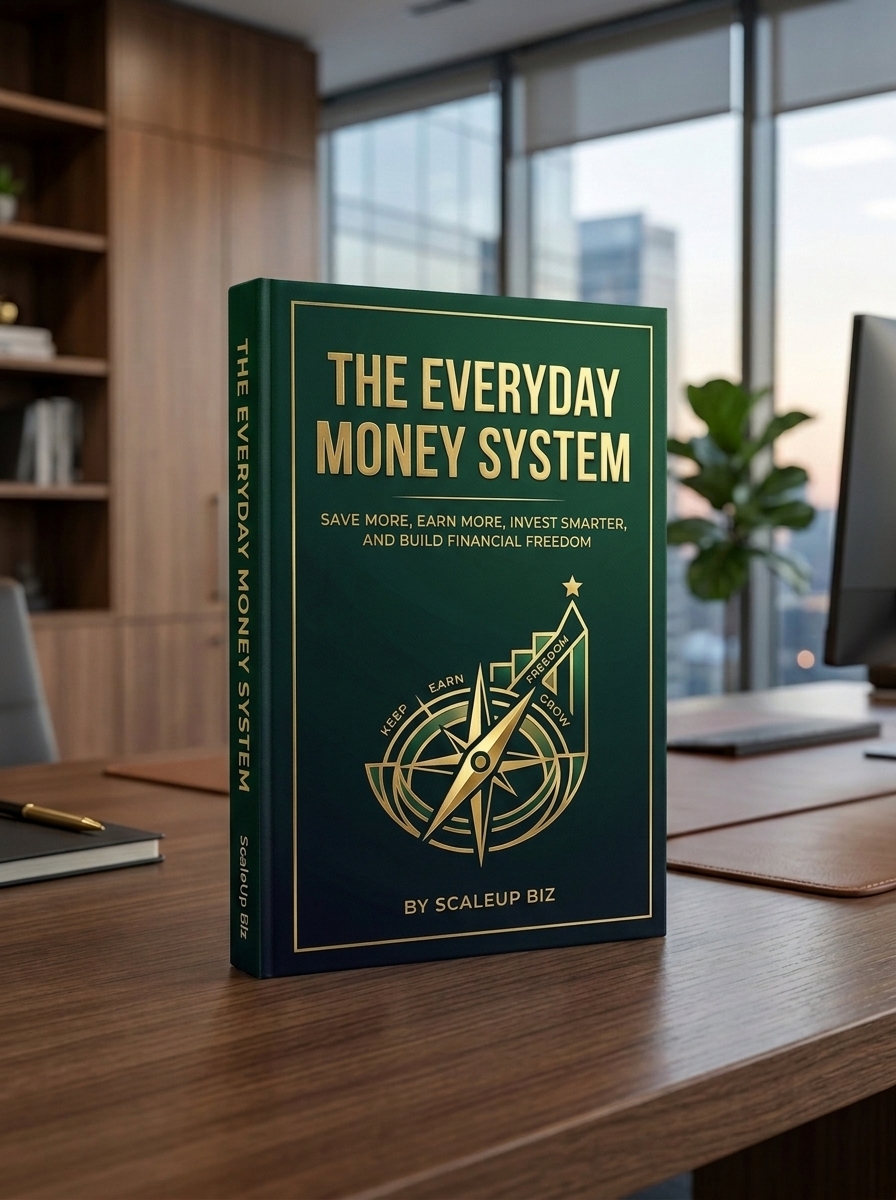
The Everyday Money System Cover $9

The Everyday Money System

✓ 83 Pages + 16 Finance Workbooks

Manage salary, pay off debt, build an emergency cushion, and invest for long-term compounding.

Explore Handbook →

The 1% Daily System Cover $9

The 1% Daily System

✓ 120 Pages + 5 Habit Worksheets

30 small daily micro-habits that compound into transformative personal and professional growth.

Explore Handbook →

The AI-Powered Small Business Playbook Cover $19

The AI-Powered Small Business Playbook

✓ 665 Pages + 200+ Prompt Vault

200+ ready-to-use prompts, automation workflows, and time-saving playbooks for business owners.

Explore Handbook →
★ Complete 4-in-1 Master Vault

Get All 4 E-Books + All Companion Tools

Unlock Trade With Rules, The Everyday Money System, The 1% Daily System, and The AI Small Business Playbook + all 16 trading calculators, personal budget sheets, and 200+ prompt vault together.